OUR METHOD
The Dog Grove Method
Train and Respect, Not Bribery.
Every dog has the potential to be calm, confident, and well-behaved. Our no-treat, touch-based training method is built on thirty years of understanding how dogs actually think, and what they need from us to thrive.
Why Dogs Struggle
Your Dog Isn't Bad.
It's Confused.
The jumping. The pulling. The barking. The destruction left behind when they're home alone. For many families, daily life with their dog becomes a struggle, and most owners blame the breed, the age, or the dog's personality.
The real cause is simpler. These behaviors are almost always symptoms of a deeper issue: a dog searching for clarity, structure, and guidance, and not finding it.
Nearly every behavioral problem we see traces back to one thing: a dog that has assumed, or is anxiously auditioning for, the leadership role in your home. Not out of spite. Out of instinct. When a pack seems leaderless, a dog promotes itself, because in its mind, someone has to organize the pack for survival.
Pack Psychology
A Dog Only Needs to Know Two Things.
Regardless of breed, every dog sees the world as a pack animal, and sees the humans in its home as strange two-legged dogs in its pack. To feel calm and secure, a dog needs clear answers to exactly two questions:
"Who is in my pack?"
Your dog needs to know exactly who belongs to its family unit. This is the foundation of its entire social world.
"What is the pecking order?"
Your dog needs to know where it stands. When the order is clear and the human leads, anxiety disappears.
Answer both questions clearly, and almost everything else takes care of itself.
Early Warning Signs
Is Your Dog Quietly Promoting Itself?
A little rambunctiousness is normal, roughly ten percent. Beyond that, these behaviors signal pack-order confusion:
Check all that apply
Select two or more to see our recommendation.
The Treat Trap
Why Treat Training Makes It Worse.
Here's what most trainers won't tell you. In pack logic, food is status.
The pack member who surrenders its food is the subordinate. The one who receives it is dominant. Every time you hand your dog a treat to buy a behavior, you're not rewarding obedience, you're confirming, in the only language your dog truly understands, that you are the weaker member of its pack.
That's why treat-trained dogs so often become more demanding, more anxious, and less reliable over time. The method itself feeds the problem it's trying to solve.
Dogs don't train like seals.
"If your dog only listens when there's a treat in your hand, you don't have a trained dog. You have a contractor."
— Edgar Hernandez, Co-Founder & Lead Certified Trainer
The Remedy
Touch. Praise. Structure.
Positive reinforcement doesn't require food. It requires connection. We replace the treat pouch with the three things a dog actually wants from its leader:
Physical Touch
Petting and physical affection are the reward, delivered by the pack leader, on the pack leader's terms. It builds connection instead of transaction.
Verbal Praise
Your voice becomes the marker of a job well done. No pouch required. Your dog listens to you, not your pocket.
Earned Structure
Training becomes the precursor to good experiences, the walk, the fetch, the snuggle. Your dog learns that calm obedience opens every door.
Through structured obedience, consistent leadership, and proven methods refined over thirty years, we transform confusion into confidence and chaos into calm.
We do the work. You enjoy the results.
Why Facility-Based Training
Train Where It's Hard. Easy Takes Care of Itself.
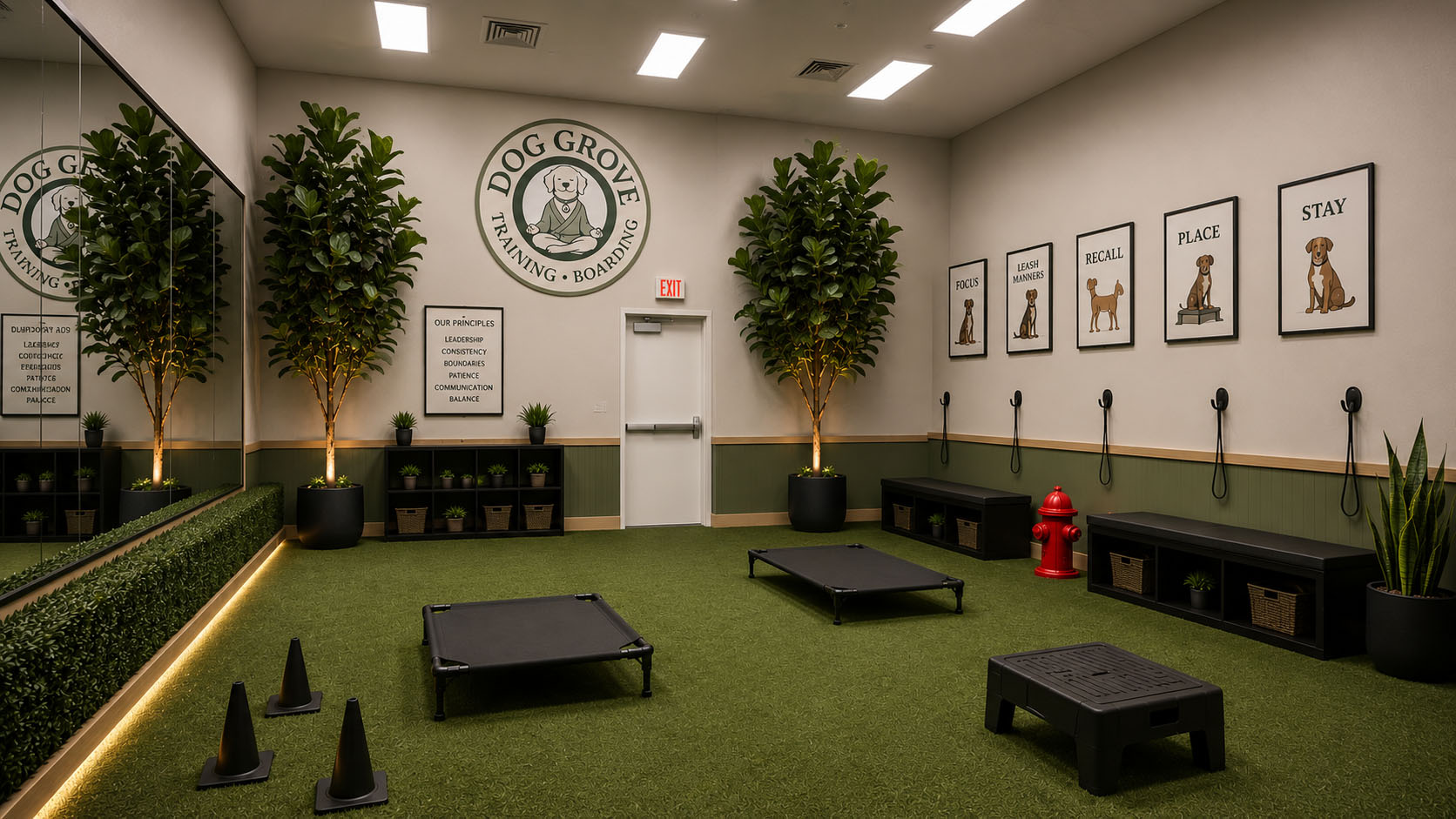
Your living room has the distractions your living room has, period. Real obedience means your dog listens around other dogs, new people, unfamiliar sounds, and high-energy environments. Our learning center is engineered for exactly that. The more we train your dog around real distractions, the more refined they become in the real world.
"Train where it's hard, and easy takes care of itself."
This is the foundation of our Board & Train program and our semi-private Group Lessons — capped at six dogs, always.
You don't train a dog. You build a relationship. The training is just what's left over when the relationship works.
Common Questions
Questions About Our Method
Yes, often more effective long-term than food-based methods. No-treat training builds obedience through physical touch, verbal praise, and structure, so your dog listens to you rather than to a treat pouch. Dogs trained this way respond reliably in real-world environments, with or without food present.
In pack logic, surrendering food signals subordination. Each treat handed over can confirm to the dog that the human is the weaker pack member, which increases dominance behaviors and anxiety over time. Many demanding, pushy, or unreliable behaviors trace directly back to food-based training.
Play biting and jumping are early signs of elevated dominance; a puppy testing for, or assuming, the leadership role in your home. It isn't spite; it's instinct. Clear structure, consistent leadership, and proper obedience training resolve it before it hardens into an adult habit.
Stealing personal items is a classic pack-order signal. Your scent makes those items valuable, and claiming them is your dog quietly testing its status. Paired with leash-pulling or crate resistance, it usually points to pack-order confusion rather than mischief.
Pulling is leading, and leading is the pack leader's job. A dog that drags you down the street believes it holds that role. Structured leash work re-establishes who leads, and the pulling resolves as the dog relaxes into its proper place in the pack.
A growing dislike of confinement often signals a dog that believes it should be in charge; leaders don't accept being contained. If crate resistance appeared alongside hyperactivity or jumping, it's likely pack-order confusion, and structured training typically resolves both together.
Calm Training. Lasting Harmony.
20 private kennels. Limited Board & Train slots. The longer you wait, the harder unwanted habits are to undo.
